Key takeaways:
– Bitcoin fell below $63,000 after weak US jobs data and growing investor risk aversion tied to AI capex.
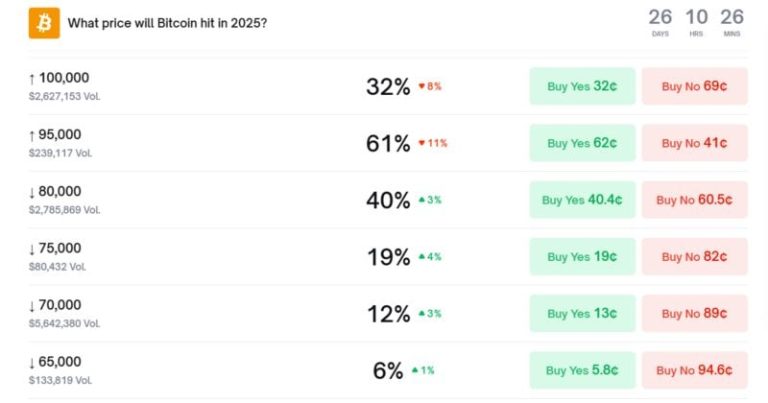
– Options markets price roughly a 6% chance of BTC reaching $90,000 by March.
Bitcoin (BTC) slid under $63,000 on Thursday, its lowest level since November 2024, completing about a 30% decline since failing to break $90,500 on Jan. 28. Traders are skeptical of an immediate bullish reversal amid worsening macro sentiment, driven by softer US employment indicators and concern over massive capital spending in the AI sector.
Options market pricing suggests a low probability of a near-term surge. On Deribit, the March 27 call allowing purchase of Bitcoin at $90,000 traded at $522 on Thursday. Using standard pricing models, that level implies less than a 6% chance of BTC reaching $90,000 by late March. By contrast, the March 27 $50,000 put traded around $1,380, implying about a 20% probability of a deeper drop.
Two themes have amplified selling pressure. First, quantum computing fears have returned to the conversation, with some strategists and allocators trimming Bitcoin exposure over speculative risks that future quantum advances could threaten current cryptographic private keys. Second, investors worry that companies holding large on-chain BTC reserves — some financed with debt or equity — may be forced to liquidate if the market remains weak. MicroStrategy (MSTR US), the largest publicly listed holder of on-chain Bitcoin, recently saw enterprise value fall below its cost basis; other corporates face similar gaps.
Broader market risk-off extended beyond crypto. Silver plunged from a Jan. 29 record high, losing roughly 36% in a week. Several billion-dollar public companies, including Thomson Reuters, PayPal, Robinhood and AppLovin, experienced stock declines roughly mirroring Bitcoin’s weekly losses.
Labor-market data also added to the dour outlook: US employers announced 108,435 layoffs in January, up 118% from January 2025 and the highest January total since 2009, according to Challenger, Gray & Christmas. Meanwhile, tech-sector headlines heightened concerns about investment timing and supply constraints: Google said 2026 capital expenditure will rise to $180 billion from $91.5 billion in 2025, and Qualcomm cut guidance after suppliers redirected capacity toward high-bandwidth memory for data centers. Traders fear AI investments will take longer to pay off amid competition, energy and chip shortages.
Together, these factors have raised risk aversion and weighed on Bitcoin’s price. The drop to about $62,300 on Thursday reflects uncertainty over economic growth and employment, making a quick rebound to $90,000 increasingly unlikely in the eyes of options market participants.
This article does not contain investment advice or recommendations. Every investment and trading move involves risk, and readers should conduct their own research when making a decision. While we strive to provide accurate and timely information, Cointelegraph does not guarantee the accuracy, completeness, or reliability of any information in this article. This article may contain forward-looking statements that are subject to risks and uncertainties. Cointelegraph will not be liable for any loss or damage arising from your reliance on this information.